FTSE 100 research guide
Original research published on . References to quote availability in the original study describe the service on its review date.
Independent guide to FTSE 100: index methodology, verified constituent examples, market drivers, risk factors and official sources. Price-feed status explained.
- Market
- United Kingdom
- Constituents
- 100 large companies
- Weighting method
- free-float market-cap weighted
Index overview and methodology
FTSE 100 measures one hundred highly capitalized blue-chip companies listed on the London Stock Exchange, with scheduled quarterly reviews. Its global sector exposure means it is not simply a measure of the UK domestic economy. Currency movements may alter the sterling value of international earnings.
Geography and market coverage
This benchmark follows securities associated with United Kingdom, but it cannot stand in for every listed business or the entire domestic economy. Interpreting its change requires distinguishing index level, percentage move, membership breadth and company fundamentals.
Why the weighting method matters
The weighting method is free-float market-cap weighted. Constituents do not necessarily have equal influence. Share-price adjustments, free float and corporate actions may affect calculations, so comparing index movements requires more than simply counting advancing stocks.
What moves the benchmark?
Key factors to research include Sterling exchange rates, commodity prices, financial-sector profitability, Bank of England policy and international earnings. No one variable guarantees the index direction. Investors should assess reported corporate data, expectations, broad economic conditions and international risk.
Earnings, discount rates and valuation
Expected earnings, profit margins, financing costs and government bond yields influence share valuations differently across sectors. An index may decline after apparently strong financial results if the market had expected still more growth.
Sector mix and concentration
Index-level advances can be concentrated in a few companies or sectors. Sector weights, top constituent contributions, rebalancing and market breadth are essential checks before extrapolating a benchmark move to the whole market.
Constituent companies and membership
The table below shows dated, source-supported component examples where available, without individual stock prices. It does not imply that a partial sample is the complete current constituent list. Full membership must be verified with the index administrator.
Index value, market hours and timestamps
No live index value is shown until a licensed feed covering the underlying benchmark has been confirmed. A future five-minute update process will record observation time, market status and delay, and will not confuse an ETF or CFD quote with the index itself.
Index versus ETF versus CFD
An index is a calculated benchmark rather than a directly owned security. ETFs are funds with distinct holdings, costs and traded prices. CFDs are derivatives with leverage and financing/liquidation risk and generally provide no ownership of constituent shares.
Investment and interpretation risks
Material risks include market volatility, interest rates, liquidity, currency movement, sector or country concentration and index reconstitution. Historical returns are not promises of future results. Suitability depends on the investor and product.
How to use this research page
Start with the index operator and calculation method, check the sample membership date, distinguish price return from total return variants, and verify the provenance and timestamp of any future index level. Follow official methodology rather than promotional price claims.
Index membership at the review date
This research list comes from a secondary source. Verification against the official index provider was pending at the archive date.
| Company | Ticker | ISIN |
|---|---|---|
| 3i | III | GB00B1YW4409 |
| Aberdeen Group | ABDN | GB00BF8Q6K64 |
| Admiral Group | ADM | GB00B02J6398 |
| Airtel Africa | AAF | GB00BKDRYJ47 |
| Alliance Witan | ALW | GB00B11V7W98 |
| Anglo American plc | AAL | GB00BTK05J60 |
| Antofagasta plc | ANTO | GB0000456144 |
| Associated British Foods | ABF | GB0006731235 |
| AstraZeneca | AZN | GB0009895292 |
| Autotrader Group | AUTO | GB00BVYVFW23 |
| Aviva | AV | GB00BPQY8M80 |
| Babcock International | BAB | GB0009697037 |
| BAE Systems | BA | GB0002634946 |
| Balfour Beatty | BBY | GB0000961622 |
| Barclays | BARC | GB0031348658 |
| Barratt Redrow | BTRW | GB0000811801 |
| BP | BP | GB0007980591 |
| British American Tobacco | BATS | GB0002875804 |
| British Land | BLND | GB0001367019 |
| BT Group | BT.A | GB0030913577 |
| Bunzl | BNZL | GB00B0744B38 |
| Burberry Group | BRBY | GB0031743007 |
| Centrica | CNA | GB00B033F229 |
| Coca-Cola Europacific Partners | CCEP | GB00BDCPN049 |
| Coca-Cola HBC | CCH | CH0198251305 |
| Compass Group | CPG | GB00BD6K4575 |
| Computacenter | CCC | GB00BV9FP302 |
| Convatec | CTEC | GB00BD3VFW73 |
| Croda International | CRDA | GB00BJFFLV09 |
| DCC Energy | DCC | IE0002424939 |
| Diageo | DGE | GB0002374006 |
| Diploma | DPLM | GB0001826634 |
| EasyJet | EZJ | GB00B7KR2P84 |
| Endeavour Mining | EDV | GB00BL6K5J42 |
| Experian | EXPN | GB00B19NLV48 |
| F & C Investment Trust | FCIT | GB00BS88V647 |
| Fresnillo plc | FRES | GB00B2QPKJ12 |
| Games Workshop | GAW | GB0003718474 |
| Glencore | GLEN | JE00B4T3BW64 |
| GSK plc | GSK | GB00BN7SWP63 |
| Haleon | HLN | GB00BMX86B70 |
| Halma plc | HLMA | GB0004052071 |
| Hiscox | HSX | BMG4593F1389 |
| Howdens Joinery | HWDN | GB0005576813 |
| HSBC | HSBA | GB0005405286 |
| ICG | ICG | GB00BYT1DJ19 |
| IG Group | IGG | GB00B06QFB75 |
| IHG Hotels & Resorts | IHG | GB00BHJYC057 |
| IMI | IMI | GB00BGLP8L22 |
| Imperial Brands | IMB | GB0004544929 |
| Informa | INF | GB00BMJ6DW54 |
| International Airlines Group | IAG | ES0177542018 |
| Intertek | ITRK | GB0031638363 |
| Investec | INVP | GB00B17BBQ50 |
| Ithaca Energy | ITH | GB00BPJHV584 |
| JD Sports | JD | GB00BM8Q5M07 |
| Lion Finance Group | BGEO | GB00BF4HYT85 |
| Kingfisher plc | KGF | GB0033195214 |
| Land Securities | LAND | GB00BYW0PQ60 |
| Legal & General | LGEN | GB0005603997 |
| Lloyds Banking Group | LLOY | GB0008706128 |
| LondonMetric Property | LMP | GB00B4WFW713 |
| London Stock Exchange Group | LSEG | GB00B0SWJX34 |
| M&G | MNG | GB00BKFB1C65 |
| Marks & Spencer | MKS | GB0031274896 |
| Melrose Industries | MRO | GB00BNGDN821 |
| Metlen Energy & Metals | MTLN | GB00BTQGS779 |
| National Grid plc | NG | GB00BDR05C01 |
| NatWest Group | NWG | GB00BM8PJY71 |
| Next plc | NXT | GB0032089863 |
| Pearson plc | PSON | GB0006776081 |
| Pershing Square Holdings | PSH | GG00BPFJTF46 |
| Polar Capital Technology Trust | PCT | GB00BR3YV268 |
| Prudential plc | PRU | GB0007099541 |
| Reckitt | RKT | GB00BSZBP530 |
| RELX | REL | GB00B2B0DG97 |
| Rentokil Initial | RTO | GB00B082RF11 |
| Rio Tinto | RIO | GB0007188757 |
| Rolls-Royce Holdings | RR | GB00B63H8491 |
| Sage Group | SGE | GB00B8C3BL03 |
| Sainsbury's | SBRY | GB00B019KW72 |
| Scottish Mortgage Investment Trust | SMT | GB00BLDYK618 |
| Segro | SGRO | GB00B5ZN1N88 |
| Severn Trent | SVT | GB00B1FH8J72 |
| Shell plc | SHEL | GB00BP6MXD84 |
| Smiths Group | SMIN | GB00B1WY2338 |
| Smith & Nephew | SN | GB0009223206 |
| Spirax Group | SPX | GB00BWFGQN14 |
| SSE plc | SSE | GB0007908733 |
| Standard Chartered | STAN | GB0004082847 |
| Standard Life | SDLF | GB00BGXQNP29 |
| St. James's Place | STJ | GB0007669376 |
| Tesco | TSCO | GB00BLGZ9862 |
| Tritax Big Box REIT | BBOX | GB00BG49KP99 |
| Unilever | ULVR | GB00BVZK7T90 |
| United Utilities | UU | GB00B39J2M42 |
| Vodafone Group | VOD | GB00BH4HKS39 |
| Weir | WEIR | GB0009465807 |
| Whitbread | WTB | GB00B1KJJ408 |
| WPP | WPP | JE00B8KF9B49 |
Questions about the index methodology
What is the FTSE 100?
A benchmark covering 100 large companies using a free-float market-cap weighted methodology.
Can an investor buy an index itself?
No. An index is a calculated benchmark. ETFs and CFDs may offer different types of exposure with distinct ownership and risk characteristics.
Are the displayed quotes live?
No quote is displayed until a licensed primary index feed has been verified. ETF or CFD prices are not substituted.
Does the constituent list stay unchanged?
No. Membership and weights change after periodic index reviews and corporate actions; check the source and as-of date.
Do all constituents rise and fall together?
No. Weighted benchmarks can be driven by a handful of large or highly weighted constituents.
Is this an investment recommendation?
No. This page provides educational research and does not recommend specific trading actions.
FTSE 100 research supplement
Supplement dated
What the quarterly ranking can tell you
A company approaching one hundredth place is often described as a candidate for the FTSE 100. At the ordinary quarterly review, FTSE Russell ranks eligible companies by their full market value. A new candidate reaching ninetieth place or better qualifies for entry under the ranking rule. A member falling to one hundred and eleventh place or lower qualifies for removal. If the number of entries and exits differs, the rules balance the two to keep one hundred constituents. A company briefly crossing a threshold during a trading session therefore tells you little without the ranking on the review date.
How available shares affect a company’s influence
Imagine two eligible companies each valued at ten billion pounds. Suppose the share of equity available to public investors is eighty per cent at the first company and forty per cent at the second. With these simplified assumptions their respective investable values are eight billion and four billion pounds. An identical percentage price rise at each would give the first roughly twice the influence of the second. To reproduce a historical weight, use the share count and free float factor applicable on the day in question. Combining an old price with figures from a later share issue can materially change your answer.
Reading a price quoted in pence
London share quotes can appear in pence, while market capitalisations are commonly expressed in pounds. Consider a hypothetical constituent at 250 pence that has 400 million shares outstanding. The share price equals £2.50, producing a full market value of £1 billion. With a sixty per cent free float, the investable figure in this example is £600 million. Reading the displayed number as £250 would multiply both values by one hundred. Keep the quote currency, unit and number of shares beside the calculation. The resulting amount can then be compared with the other constituents on a consistent basis.
What a sterling move can do to reported sales
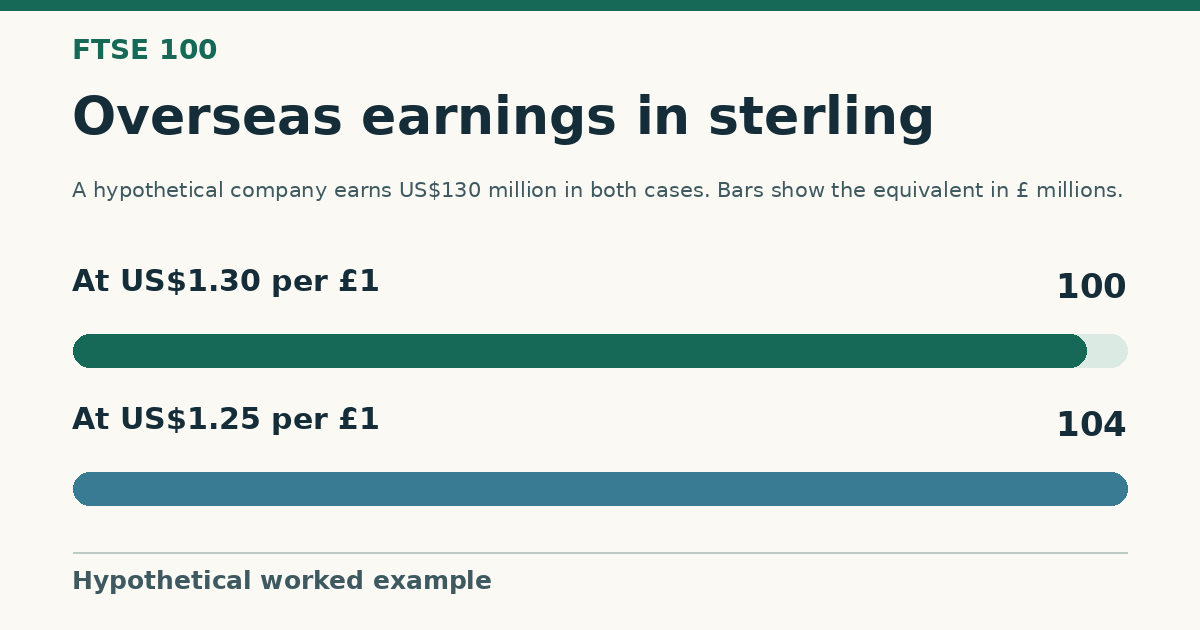
Suppose a London constituent sells goods worth 120 million US dollars abroad in each of two periods. At an assumed exchange rate of 1.20 dollars per pound, the sales translate into £100 million. At 1.25 dollars per pound they translate into £96 million, even with unchanged dollar revenue. A reported decline in sterling sales can therefore coexist with stable demand in the overseas market. A company may also pay suppliers in dollars, borrow in that currency or hedge future receipts. The geographical sales breakdown and the accounts’ exchange rate notes help explain how much of the translation effect reaches earnings.
Reconstructing a week around a review
A dated composition table records who belonged to the index on its reference date. To reconstruct a week spanning a review, look up the administrator’s notice and its effective date. Use the outgoing basket through its last applicable session and the incoming basket from its first. The September 2026 notice, for example, announced two FTSE 100 additions and two deletions. It provides a dated record for checking a report from that month. Applying a later list retrospectively can assign the week’s price movement to a company that only joined afterwards, even if all the historical share prices are accurate.