DAX 40 research guide
Original research published on . References to quote availability in the original study describe the service on its review date.
Independent guide to DAX 40: index methodology, verified constituent examples, market drivers, risk factors and official sources. Price-feed status explained.
- Market
- Germany
- Constituents
- 40 companies
- Weighting method
- free-float market-cap weighted
Index overview and methodology
DAX represents forty major listed German blue-chip companies and is weighted by free-float market capitalization subject to index methodology. One essential distinction is the quoted index variant: the commonly followed DAX performance index includes reinvested dividends, whereas a DAX price index does not. Comparing levels without checking the variant is misleading.
Geography and market coverage
This benchmark follows securities associated with Germany, but it cannot stand in for every listed business or the entire domestic economy. Interpreting its change requires distinguishing index level, percentage move, membership breadth and company fundamentals.
Why the weighting method matters
The weighting method is free-float market-cap weighted. Constituents do not necessarily have equal influence. Share-price adjustments, free float and corporate actions may affect calculations, so comparing index movements requires more than simply counting advancing stocks.
What moves the benchmark?
Key factors to research include German manufacturing orders, China demand, European Central Bank rates, the euro, industrial energy costs and export conditions. No one variable guarantees the index direction. Investors should assess reported corporate data, expectations, broad economic conditions and international risk.
Earnings, discount rates and valuation
Expected earnings, profit margins, financing costs and government bond yields influence share valuations differently across sectors. An index may decline after apparently strong financial results if the market had expected still more growth.
Sector mix and concentration
Index-level advances can be concentrated in a few companies or sectors. Sector weights, top constituent contributions, rebalancing and market breadth are essential checks before extrapolating a benchmark move to the whole market.
Constituent companies and membership
The table below shows dated, source-supported component examples where available, without individual stock prices. It does not imply that a partial sample is the complete current constituent list. Full membership must be verified with the index administrator.
Index value, market hours and timestamps
No live index value is shown until a licensed feed covering the underlying benchmark has been confirmed. A future five-minute update process will record observation time, market status and delay, and will not confuse an ETF or CFD quote with the index itself.
Index versus ETF versus CFD
An index is a calculated benchmark rather than a directly owned security. ETFs are funds with distinct holdings, costs and traded prices. CFDs are derivatives with leverage and financing/liquidation risk and generally provide no ownership of constituent shares.
Investment and interpretation risks
Material risks include market volatility, interest rates, liquidity, currency movement, sector or country concentration and index reconstitution. Historical returns are not promises of future results. Suitability depends on the investor and product.
How to use this research page
Start with the index operator and calculation method, check the sample membership date, distinguish price return from total return variants, and verify the provenance and timestamp of any future index level. Follow official methodology rather than promotional price claims.
Index membership at the review date
Dated constituents compiled from secondary sources and cross-checked with STOXX review notices; not the licensed administrator list. Membership may change.
| Company | Ticker |
|---|---|
| Adidas | ADS |
| Airbus | AIR |
| Allianz | ALV |
| BASF | BAS |
| Bayer | BAYN |
| Beiersdorf | BEI |
| BMW | BMW |
| Brenntag | BNR |
| Commerzbank | CBK |
| Continental | CON |
| Daimler Truck | DTG |
| Deutsche Bank | DBK |
| Deutsche Börse | DB1 |
| DHL Group | DHL |
| Deutsche Telekom | DTE |
| E.ON | EOAN |
| Fresenius | FRE |
| Fresenius Medical Care | FME |
| GEA Group | G1A |
| Hannover Re | HNR1 |
| Heidelberg Materials | HEI |
| Henkel | HEN3 |
| HOCHTIEF | HOT |
| Infineon Technologies | IFX |
| Mercedes-Benz Group | MBG |
| Merck KGaA | MRK |
| MTU Aero Engines | MTX |
| Munich Re | MUV2 |
| Qiagen | QIA |
| Rheinmetall | RHM |
| RWE | RWE |
| SAP | SAP |
| Scout24 | G24 |
| Siemens | SIE |
| Siemens Energy | ENR |
| Siemens Healthineers | SHL |
| Symrise | SY1 |
| Volkswagen preference shares | VOW3 |
| Vonovia | VNA |
| Zalando | ZAL |
Questions about the index methodology
What is the DAX 40?
A benchmark covering 40 companies using a free-float market-cap weighted methodology.
Can an investor buy an index itself?
No. An index is a calculated benchmark. ETFs and CFDs may offer different types of exposure with distinct ownership and risk characteristics.
Are the displayed quotes live?
No quote is displayed until a licensed primary index feed has been verified. ETF or CFD prices are not substituted.
Does the constituent list stay unchanged?
No. Membership and weights change after periodic index reviews and corporate actions; check the source and as-of date.
Do all constituents rise and fall together?
No. Weighted benchmarks can be driven by a handful of large or highly weighted constituents.
Is this an investment recommendation?
No. This page provides educational research and does not recommend specific trading actions.
DAX 40 research supplement
Supplement dated
Comparing DAX figures across dividend season
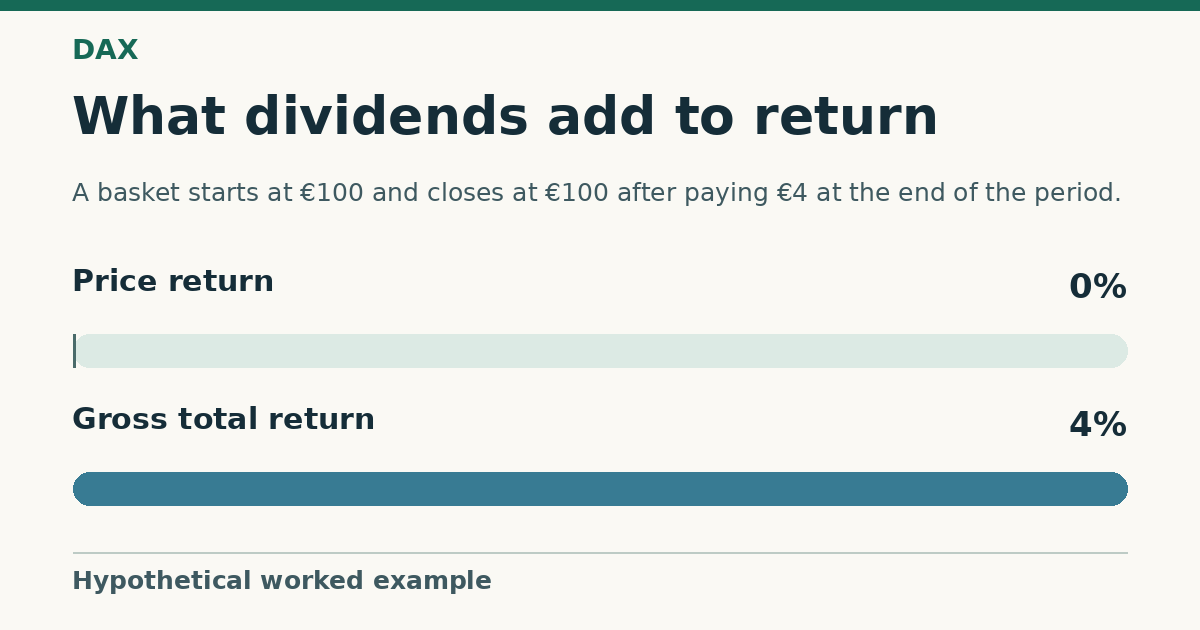
Imagine an illustrative basket worth one hundred euros. Its companies distribute two euros in cash, and the shares alone finish the period worth ninety-eight. Holding everything else constant, the price series shows a two percent decline, while shares plus cash add up to one hundred euros before tax and costs. This single-period example explains why two screens labelled DAX can follow different paths through a dividend season. The commonly quoted German performance benchmark assumes dividend reinvestment, and the administrator also publishes a price version. A holder measuring the return of a distributing fund needs the cash paid per unit as well as its closing unit price.
Working from a company’s size to its investable weight
Consider two companies that have each issued one hundred million shares trading at twenty euros. Both have a full market value of two billion euros. Suppose half of the first company’s shares and four fifths of the second company’s shares are free floating. Their free-float market values become one billion and one point six billion euros. Identical percentage moves can therefore have different effects on DAX. Applicable capping factors and the rest of the basket also matter to the official weights. To explain a past session, use its opening weights. A weight measured after a rally already incorporates some of the price movement under examination.
Putting two conflicting earnings headlines into numbers
Suppose a constituent begins a session at an eight percent weight and rises three percent. Its contribution is approximately 0.24 percentage points of index return. Another starts at six percent and falls two percent, subtracting approximately 0.12 percentage points. Together the two contribute a positive 0.12 percentage points, assuming fixed membership and no dividends or special events during the interval. The biggest headline could still describe the declining company. Counting advancing shares measures how widely gains were shared. Adding weighted contributions measures which companies drove the published figure. Recording both statistics makes it possible to describe a narrow rally more precisely.
Matching a historical earnings event to the right membership
To study a past earnings season, identify the constituents on each announcement date. Using today’s list across several years imports observations from before some companies joined and drops earlier members that have since left. For each release, note the announcement time, the first session in which the shares could react and the effective date of any nearby index review. An after-close release cannot explain the closing price already recorded that afternoon. A record of the traded share class and its identifier also helps when a company changes its name or when two listed classes of the same business trade separately.
Connecting a German export figure to company returns
An improving export statistic and a falling DAX can occur in the same week. First date the period covered by the economic series and the day it became public. Then identify businesses with material sales in the specific region or product group described. One company’s reported euro revenue might rise solely because its foreign sales translated at a different exchange rate. Another may face higher euro costs for inputs invoiced in dollars. Constant-currency sales and disclosures about hedging help distinguish those two mechanisms. Only after identifying which businesses were affected does their starting weight reveal how much of the index move the explanation could account for.